
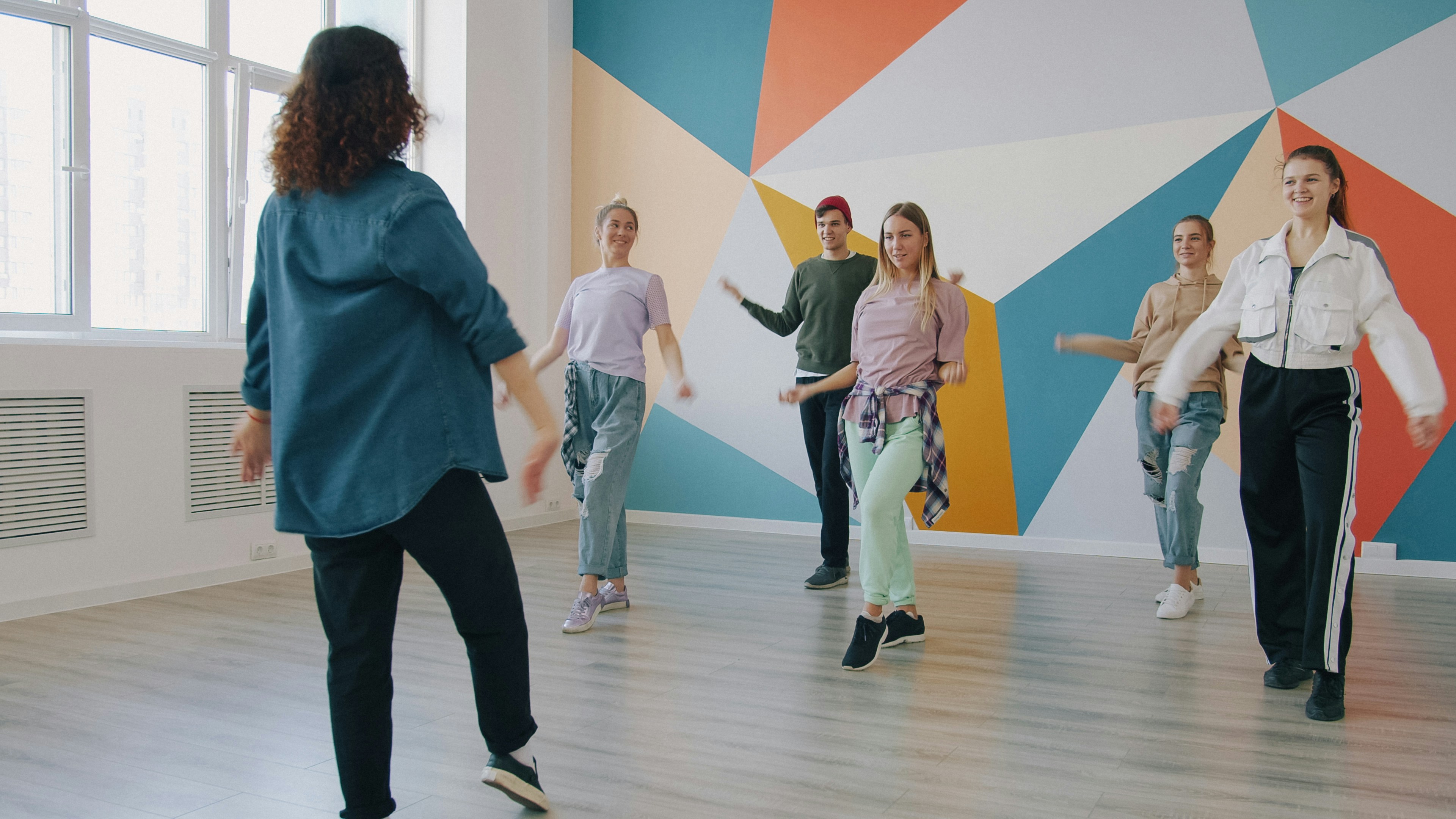
Quick Answer: Practicing dance at home without a teacher works when you mimic what a teacher actually gives you. A teacher demonstrates the movement, gives you feedback, and holds you accountable. You can build all three into your home practice with the right method and the right tools. Then, when you are ready, you can walk into a studio with confidence instead of fear.
You want to learn dance. But you do not have a teacher.
Maybe there is no studio near you. Maybe classes are too expensive. Maybe you are not ready to dance in front of a room full of strangers yet.
So you are on your own. And that raises a real question: can you actually learn dance without someone watching you and correcting you?
The answer is yes. But it depends on how you practice.
What a Teacher Actually Does
Before you can mimic a teacher, you need to understand what a teacher is actually giving you.
It is not just the choreography. You can get that from a video.
A teacher gives you three things.
A demonstration
They show you what the movement looks like. They break it down. Foot placement, arm position, timing.
Feedback
They watch you try it and tell you what you are doing wrong. Your foot is turned out. Your weight is on the wrong leg.
Accountability
You show up because someone is expecting you. You practice because you paid for the class.
When you practice at home, you have to build all three of these into your routine.
Most people only build the first one. They watch the video and assume that is enough. It is not.
The Mistake Most People Make
Here is what most people do when they practice at home.
They find a video. They watch it once. They stand up and try to follow along. They get lost. They rewind. They try again. They get frustrated. They quit.
The problem is not that they are practicing alone. The problem is that they are trying to do everything at once.
They are trying to learn the choreography, check their form, and keep up with the music, all at the same time. That is too much for anyone.
The solution is to separate these tasks. Watch first. Then match. Then move.
How to Mimic a Teacher: The Three-Part System
Here is how to build the teacher's three jobs into your own practice until you find a real one.
Part 1: Mimic the Demonstration
The teacher's first job is to show you what to do. You can mimic this with a video, but you have to use the video correctly.
Do not watch at full speed. Slow it down. Study the movement. Look for foot placement, arm position, weight shifts, and timing.
This is the Watch phase. It is not optional. It is how you build the mental map that makes everything else possible.
How Avonya helps: The Watch phase is built into every routine. You study the pro at a pace your brain can actually process. No pressure. Just clarity.
Part 2: Mimic the Feedback
This is the hard one. Without a teacher, nobody is telling you when you are doing it wrong.
The solution is to give yourself visual feedback.
Use a mirror. This is the oldest trick in the book. Stand in front of a mirror and check your form.
Film yourself. This is even better than a mirror. Film yourself doing the routine and watch it back. Compare it to the tutorial. Notice what is different.
Use a visual guide. This is what Avonya does. Phantom Mode shows you exactly where to place your feet and hands on your camera feed. You match the guide and feel the moves on your body. It is like having a teacher standing next to you, showing you exactly where to go.
How Avonya helps: Phantom Mode gives you real-time visual feedback. You do not have to guess whether your foot is in the right place. You can see it.
Part 3: Mimic the Accountability
Nobody is expecting you to show up. So you have to expect it of yourself.
Here is what works.
- Set a small goal. Not "learn this dance." That is too big. "Practice for 15 minutes today." That is achievable.
- Pick a time. Same time every day. Before work. After dinner. Right before bed. Consistency beats intensity.
- Track it. Put a checkmark on a calendar. The streak becomes its own motivation.
- Make it easy to start. Leave your phone or tablet where you practice. Wear clothes you can move in. Remove every excuse.
How Avonya helps: Every routine is broken down into bite-sized chapters. You do not need an hour. You need 15 minutes. You can practice one section and feel like you made progress.
The Home Practice Routine That Works
Here is a simple routine you can follow every time you practice.
| Step | What You Do | Time |
|---|---|---|
| 1. Watch | Study the section you are working on at slow speed | 2 minutes |
| 2. Match | Use the visual guide to practice the movement | 5 minutes |
| 3. Move | Practice without the guide, then with music | 5 minutes |
| 4. Review | Film yourself and compare | 3 minutes |
That is 15 minutes. You can do it every day.
What You Miss Without a Teacher (And How to Compensate)
Let us be honest about the limitations.
| What You Miss | How to Compensate |
|---|---|
| Instant correction | Film yourself and compare to the tutorial |
| A structured curriculum | Use an app with a built-in method |
| Social motivation | Set your own goals and track your streak |
| A live audience | Join a community or share your progress online |
| Professional eyes on your form | Use a visual guide like Phantom Mode |
You will not get everything a teacher gives you. But you can get enough to make real progress until you are ready to find one.
When You Are Ready to Find a Teacher
There is a point where a teacher becomes genuinely valuable. It is usually not at the beginning.
When you are first learning, you need repetition and feedback. You can get both at home.
When you are refining technique, correcting subtle habits, or preparing for a performance, a teacher becomes more valuable.
The path is usually this: start at home, build confidence, then take a class when you are ready.
And here is the good news. By the time you walk into that studio, you will already know how to watch, how to match, and how to move. You will not be the person who feels lost. You will be the person who is ready.
How Avonya helps: The app is designed to be the place where you build enough confidence to eventually walk into a studio.
The Avonya Method: Watch, Match & Move
Avonya was built on a simple insight: dance starts by training the way you watch movement. Brain first, then body.
- Watch means you train your brain first. Study the movement slow enough that your neurons can actually process it.
- Match means you step into Phantom Mode. A visual guide on your camera feed shows you exactly where to place your feet and hands.
- Move means you let your brain's new pathways take over. Gradually increase the pace until you hit tempo.
Every routine is broken down into bite-sized chapters. You can slow down, loop, and repeat. Perfect for self-paced practice at home.
And the whole thing is private and judgment-free. Your living room is your dance studio. No one is watching. No one is judging.
Stop Waiting for a Teacher. Start Dancing.
You do not need a studio. You do not need a teacher. You do not need anyone watching you.
You need a method. You need feedback. You need a little consistency.
Mimic the teacher until you find one. And by then, you will already be dancing.
Avonya was built for people like you. People who want to learn choreography without pressure. People who need a clear, visual guide. People who want to practice privately at home.
Watch. Match. Move.
Try Avonya free and learn your first routine today.
Download on the App StoreWatch, Match & Move. Your best self is one step away.